Pages

Monday, 7 January 2019

Before You Call A Fat Person at the Gym “Brave”

Bullshit FairyThere is a concept in Fat Activism called the “Good Fatty Bad Fatty Dichotomy.” coined by Kate Harding. Basically, it’s the idea that fat people should be treated differently based on health status or performance of “health” (foods eaten, exercise undertaken etc.)

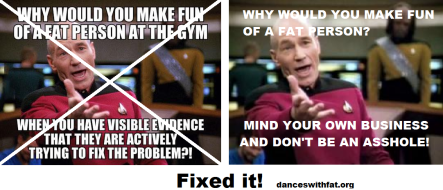
There is a more complete discussion here. The end result of this is to create hoops that fat people have to jump through in order to be treated with basic human respect by the person who is creating the hoops and judging how well fat people are jumping through them.  It’s bullshit, of course, but it’s ingrained in our culture and it comes out often in memes that are well meaning, but messed up.  Here are some that I’ve corrected:
why-would-you-make-fun-of-a-fat-person

And while we’re on the subject –  fat people’s bodies are not “problems” to be “fixed.” Extra shame on the person who created this for besmirching the good named of Captain Picard.
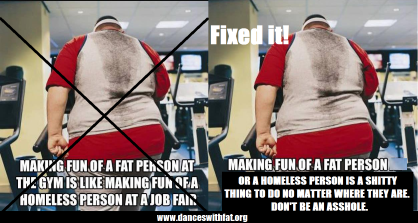
Original pictures is a fat person on a machine at the gym, photographed from behind with the caption "Making fun of a fat person at the gym is like making fun of a homeless person at a job fair." This image and caption are crossed out, the image is copied on the right with the new caption "Making fun of a fat person or a homeless person is a shitty thing to do no matter where they are. Don't be an asshole."

Another version of this compares fat people in the gym to sick people at the hospital, which is ridiculous since it pathologizes fat bodies and suggests that they have some special need to go to the gym to “fix” themselves that thinner people don’t. Super extra shame on the person who created this for using homeless people as a tool in their bullshit good fatty argument.
goals-based-on-size

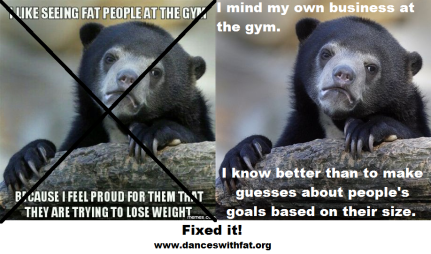
This person took the popular meme “confession bear” and turned him into “stereotyping, patronizing bear.” As Fat Activists and Health at Every Size practitioners who have been asked intrusive and clueless questions by perfect strangers at the gym (like “how much weight have you lost?”) can attest, this is crap. Don’t make assumptions about people based on their size – not at the gym, not anywhere else.
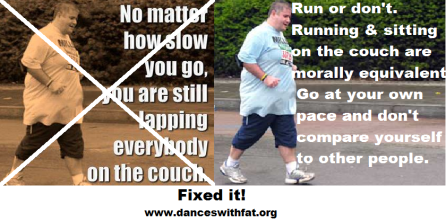
run-or-dont

Ugh.  People who are running are not morally better than people who are sitting on the couch. People who run faster are not morally better than people who run more slowly. We do not have to be “better” than someone else in order to be happy with ourselves.  I blogged more about this one here.

Or maybe you’ve seen the letter written to a fat person who was, one might assume, just trying to run around a track and not trying to be a muse for someone who wants a medal for not being as shitty and fatphobic as they possibly could.

As always, think before you meme and when you see memes that put some people down as a way to prop other people up you can remind the people who post it that it’s not necessary and, in fact, it’s extremely harmful. No more good fatty bad fatty BS please.

Did you like this post? If you appreciate the work I do, you can support my ability to do more of it with a one-time contribution or by becoming a member.

Like this blog?  Here’s more cool stuff:

The New Year Sale is on! – Give the gift of body love and/or get your own year off to a Size Acceptance and Health at Every Size start with discounts on books, online programs, and DVDs to get your year (or the year of the people you’re gifting them to) off to a great start, and save you some money! (Dances With Fat Members get even bigger discounts, so make sure to use your link on the member page.)

Wellness for All Bodies ProgramA simple, step-by-step, super efficient guide to setting and reaching your health goals from a weight-neutral perspective.  This program can be used by individuals, or by groups, including as a workplace wellness program!
Price: $25.00 ($10 for DancesWithFat members – register on the member page)

Non-Members click here for all the details and to register!

Book and Dance Class Sale!  I’m on a journey to complete an IRONMAN triathlon, and I’m having a sale on all my books, DVDs, and digital downloads to help pay for it. You get books and dance classes, I get spandex clothes and bike parts. Everybody wins! If you want, you can check it out here!

Book Me!  I’d love to speak to your organization. You can get more information here or just e-mail me at ragen at danceswithfat dot org!

I’m (still!) training for an IRONMAN! You can follow my journey at www.IronFat.com or on Instagram.

If you are uncomfortable with my offering things for sale on this site, you are invited to check out this post.


via Dances With Fat http://bit.ly/2SFpymh

Thursday, 3 January 2019

Three Easy Ways to Know If A Diet Study Sucks

LiesOne of the most frustrating things about weight loss (so-called) research, is that the media often covers any weight-loss study as if the conclusions they claim have been proven beyond a shadow of a doubt when, in fact, much of the research is embarrassingly poor – often for profit by the weight loss industry. I get a lot of questions about how to evaluate studies, and it’s a topic that can get complicated fast, but here are some easy ways to evaluate a study about a purported weight loss technique

1. Did they take their time?

This is covered in greater detail here, but basically almost everyone can lose weight short term, but almost everyone gains it back within five years. So if a study doesn’t follow subjects for at least 5 years then it’s not a valid look at whether a weight loss method works for anything more than the short term.  (This is especially important with diet companies like Noom which both claims to be a “brand new” way to diet, and simultaneously claims that they offer “permanent” weight loss. Where are they getting their long-term data? If they are “brand new,” how many people who lost weight on their program could have died having kept it off?

2. Are these people?

When it comes to the study subjects, you might think that you should start with questions like “were the study participants diverse?” But you actually need to start with the question “were the study participants human?”

I can’t even count how many times that I’ve read an article about a study and asked myself “Wait – was this rats?” and then looked it up to find that it was, in fact, done with rats as subjects. And the reporter didn’t bother to mention that while droning on about how effective this new diet is.

3. Who are these people?

If the researchers did study humans, we then have to ask how representative the sample  (the group of people who participated in the study) is. Which is to say that who they study determines to whom the study results can be appropriately extrapolated. So if they only studied white cisgender dudes, that’s the only group we can expect the results to apply to (and that’s only if they had a large enough sample – included enough white cisgender dudes – to rule out individual differences.)

A number of assumptions in medicine that have been proven false (like the idea that heart attacks have the same symptoms regardless of gender) were based on researchers’ habit of studying 150-pound cisgender white men and then extrapolating those results to literally everyone. Many studies (not just weight loss, but all studies) under-represent People of Color and completely fail to represent Trans and Non-Binary people at all. Representative samples are a huge issue, and that’s not even getting into the variables they don’t control for. So you are looking for a study with a large, diverse sample.

To date, there is not a single study where more than a tiny fraction of people were able to maintain significant weight loss long-term, so don’t be suprised if you find the weight loss studies you are analyzing are lacking in study methodology, and subject success.

If you are interested in checking out an exhaustively researched paper supporting a departure from diet culture, I recommend you head over here.

Did you like this post? If you appreciate the work I do, you can support my ability to do more of it with a one-time contribution or by becoming a member.

Like this blog?  Here’s more cool stuff:

The New Year Sale is on! – Give the gift of body love and/or get your own year off to a Size Acceptance and Health at Every Size start with discounts on books, online programs, and DVDs to get your year (or the year of the people you’re gifting them to) off to a great start, and save you some money! (Dances With Fat Members get even bigger discounts, so make sure to use your link on the member page.)

Wellness for All Bodies ProgramA simple, step-by-step, super efficient guide to setting and reaching your health goals from a weight-neutral perspective.  This program can be used by individuals, or by groups, including as a workplace wellness program!
Price: $25.00 ($10 for DancesWithFat members – register on the member page)

Non-Members click here for all the details and to register!

Book and Dance Class Sale!  I’m on a journey to complete an IRONMAN triathlon, and I’m having a sale on all my books, DVDs, and digital downloads to help pay for it. You get books and dance classes, I get spandex clothes and bike parts. Everybody wins! If you want, you can check it out here!

Book Me!  I’d love to speak to your organization. You can get more information here or just e-mail me at ragen at danceswithfat dot org!

I’m (still!) training for an IRONMAN! You can follow my journey at www.IronFat.com or on Instagram.

If you are uncomfortable with my offering things for sale on this site, you are invited to check out this post.


via Dances With Fat http://bit.ly/2F4lMPi

Wednesday, 2 January 2019

Hospitals with Midwives on Staff Have Better Outcomes


Here are two recent studies showing that hospitals with midwives and doctors practicing together ("interprofessional" centers) have better outcomes than hospitals with only doctors. One study is on first-time mothers (nulliparous), and the other study is on women who have given birth before (multiparous), to separate out the possible effects of parity.

In first-time mothers, women were much less likely to be induced or have oxytocin augmentation of labor in interprofessional/collaborative centers. The cesarean rate was 12% lower in interprofessional centers too.

For multiparous mothers (multips), women were again much less likely to be induced or have augmentation of labor in interprofessional centers. The first-time cesarean rate was 36% lower, and the Vaginal Birth After Cesarean (VBAC) rate was 31% higher than in institutions with only doctors. Neonatal outcomes were similar between the two types of centers.

The implication here is that not only do midwives lower the rates of interventions without endangering outcomes, they also influence the hospital culture in a positive way. Doctors who work with midwives tend to be more flexible about interventions, less likely to push a cesarean without need, and more likely to support VBACs.

If you are considering a hospital birth, try to choose a hospital with both doctors and midwives on staff, one with low overall cesarean rates, and strongly consider hiring a doula for professional labor support. Most women can safely be attended by a midwife, so make that your first choice if you can. If a risk comes up that means that you need to see an OB or high-risk maternal fetal medicine (MFM) specialist, the midwife will refer you to one, probably one that is supportive of the parents' birth wishes whenever conditions allow.


References

Birth. 2018 Nov 11. doi: 10.1111/birt.12407. [Epub ahead of print] Midwifery presence in United States medical centers and labor care and birth outcomes among low-risk nulliparous women: A Consortium on Safe Labor study. Neal JL, Carlson NS, Phillippi JC, Tilden EL, Smith DC, Breman RB, Dietrich MS, Lowe NK. PMID: 30417436
...Our objective was to compare labor processes and outcomes for low-risk nulliparous women birthing in United States medical centers with interprofessional care (midwives and physicians) versus noninterprofessional care (physicians only). METHODS: We conducted a retrospective cohort study using Consortium on Safe Labor data from low-risk nulliparous women who birthed in interprofessional (n = 7393) or noninterprofessional centers (n = 6982). .. women at interprofessional medical centers, compared with women at noninterprofessional centers, were 74% less likely to undergo labor induction (risk ratio [RR] 0.26; 95% CI 0.24-0.29) and 75% less likely to have oxytocin augmentation (RR 0.25; 95% CI 0.22-0.29). The cesarean birth rate was 12% lower at interprofessional centers (RR 0.88; 95% CI 0.79-0.98). Adverse neonatal outcomes occurred in only 0.3% of births and were thus too rare to be modeled. CONCLUSIONS: The care processes and birth outcomes at interprofessional and noninterprofessional medical centers differed significantly. Nulliparous women receiving care at interprofessional centers were less likely to experience induction, oxytocin augmentation, and cesarean than women at noninterprofessional centers. Labor care and birth outcome differences between interprofessional and noninterprofessional centers may be the result of the presence of midwives and interprofessional collaboration, organizational culture, or both.
Birth. 2018 Nov 9. doi: 10.1111/birt.12405. [Epub ahead of print] Influence of midwifery presence in United States centers on labor care and outcomes of low-risk parous women: A Consortium on Safe Labor study. Carlson NS, Neal JL, Tilden EL, Smith DC, Breman RB, Lowe NK, Dietrich MS, Phillippi JC. PMID: 30414200
...We sought to use national United States data to analyze the association between midwifery presence in maternity care teams and the birth processes and outcomes of low-risk parous women. METHODS: We conducted a retrospective cohort study using Consortium on Safe Labor data from low-risk parous women in either interprofessional care (n = 12 125) or noninterprofessional care centers (n = 8996). .. women at interprofessional centers, compared with women at noninterprofessional centers, were 85% less likely to have labor induced (risk ratio [RR] 0.15; 95% CI 0.14-0.17). The risk for primary cesarean birth among low-risk parous women was 36% lower at interprofessional centers (RR 0.64; 95% CI 00.52-0.79), whereas the likelihood of vaginal birth after cesarean for this population was 31% higher (RR 1.31; 95% CI 1.10-1.56). There were no significant differences in neonatal outcomes. CONCLUSIONS: Parous women have significantly higher rates of vaginal birth, including vaginal birth after cesarean, and lower likelihood of labor induction when cared for in centers with midwives. Our findings are consistent with smaller analyses of midwifery practice and support integrated, team-based models of perinatal care to improve maternal outcomes.


via The Well-Rounded Mama http://bit.ly/2ToWmQl

Monday, 31 December 2018

Swap Your Resolution for a Revolution

The world is messed up you are fineWe have reached another of the Dieting Axis of Evil days – New Year’s. Where we are inundated with messages insisting that it’s in our best interest to resolve to diet, again. The Underpants Rule is very clear on this – people are allowed to do whatever they want with their bodies and that includes attempting to manipulate their size and shape because they think it will improve their health, or that it will stop bullying and stigmatization, or for whatever reason.
People are also allowed to choose NOT to try to lose weight for whatever reason we want – whether it’s because we believe that the research shows behavior, not body size, give us the best chance for health (knowing that health is not an obligation, barometer of worthiness, or entirely within our control), or because we believe that bullying and social stigma should be solved by ending bullying and social stigma, not by giving the bullies our lunch money, or because we believe the evidence about the near-complete futility of intentional weight loss. But this time of year that group doesn’t find much support.

I get a lot of e-mails for people this time of year asking “If I’m not making a weight loss resolution, what resolution can I make?”

I’m glad you asked!

Instead of a New Years Resolution, we can make a New Year’s Revolution.  There is no doubt that we live in a culture that was created around the idea that there is there is only one standard of beauty, and that it requires digital retouching and photo illustration to achieve it.  There is so much pressure to buy into this culture where the beauty and diet industries make billions by convincing us that we are not good enough, and probably never will be, that just waking up and not hating ourselves is an act of revolution, and that’s a pretty good place to start!

With that in mind, here are some ideas to create your own New Year’s Revolution (as always, these are just suggestions,  your mileage may vary and feel free to change any of these to make them work for you.)

  • Resolve to make your first thought of every day one of gratitude for your body, maybe put a note on your ceiling that reminds you to start each day saying something like “You’re a great body and I really appreciate you” (if you need a little help finding the love, this might help.)
  • Create a little mantra to say to yourself (or, hey, out loud if you want to) every time you hear a message that’s meant to make you feel bad about yourself so that you buy a product.  My personal mantra is “Hey, that’s BULLSHIT!” but you create one that works for you (and feel free to share it in the comments if you’d like.)
  • Resolve to stop participating in negative body talk – about other people and your own body.  Start with what comes out of your own brain/mouth (when you start to have a negative thought or utterance, replace it with something positive), and then consider the conversations that you are part of. Maybe when others start body snarking you just walk away, or maybe you say “I wish we could live in a world where we saw the beauty in everyone and didn’t try to tear other people down,” or maybe you say “I made a New Year’s Revolution to stop negative body talk, I’m just not interested in being part of a toxic culture any more.”
  • Resolve to do one piece of activism every week (or day, or month, or whatever) it could be something as simple as posting something body positive to your social media, or interrupting negative body talk, or writing an e-mail to a company that is using the creation of self-loathing as a marketing tactic, or sending a thank you letter to someone who supports you on your journey to size acceptance, or posting a body positive comment to a body negative space online.
  • Resolve to reach out and join/create community – join/create a body positive club at your school or work, join/create a body positive meet-up or Facebook group, subscribe to blogs/tumblrs/instagrams etc. that support your goals
  • If you are choosing health goals, consider making them about behaviors, consider making them additive (an extra glass of water, or serving of vegetables, or hour of sleep a night) rather than choosing “never to do/eat/be [whatever] again”.
  • Resolve to cut yourself some slack if you aren’t able to do these goals 100% of the time. We’re pushing back against a tremendous amount of time, money, and energy that is invested in convincing us to buy into a culture where self-loathing is the norm, and where we see buying diet and beauty products as our only way out. So if we slip back into this mentality it’s not a big shock – I think that the best thing we can do when it happens is to recognize it and move on.

The diet and beauty industry machine that oppresses us runs on our time, energy, and money.  When we take the fuel away, the machine ceases to run.  That’s going to happen, but it’s going to take some time.  For now we can help change the whole world by changing our world, and staging a personal New Year’s Revolution.

Did you like this post? If you appreciate the work I do, you can support my ability to do more of it with a one-time contribution or by becoming a member.

Like this blog?  Here’s more cool stuff:

The New Year Sale is on! – Give the gift of body love and/or get your own year off to a Size Acceptance and Health at Every Size start with discounts on books, online programs, and DVDs to get your year (or the year of the people you’re gifting them to) off to a great start, and save you some money! (Dances With Fat Members get even bigger discounts, so make sure to use your link on the member page.)

Wellness for All Bodies ProgramA simple, step-by-step, super efficient guide to setting and reaching your health goals from a weight-neutral perspective.  This program can be used by individuals, or by groups, including as a workplace wellness program!
Price: $25.00 ($10 for DancesWithFat members – register on the member page)

Non-Members click here for all the details and to register!

Book and Dance Class Sale!  I’m on a journey to complete an IRONMAN triathlon, and I’m having a sale on all my books, DVDs, and digital downloads to help pay for it. You get books and dance classes, I get spandex clothes and bike parts. Everybody wins! If you want, you can check it out here!

Book Me!  I’d love to speak to your organization. You can get more information here or just e-mail me at ragen at danceswithfat dot org!

I’m (still!) training for an IRONMAN! You can follow my journey at www.IronFat.com or on Instagram.

If you are uncomfortable with my offering things for sale on this site, you are invited to check out this post.

Published by danceswithfat

Hi, I’m Ragen Chastain. Speaker, Writer, Dancer, Choreographer, Marathoner, Soon to be IRONMAN, Activist, Fat Person.


via Dances With Fat http://bit.ly/2BQgiV3

Sunday, 30 December 2018

The Short Term Weight Loss Lie

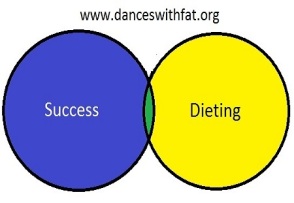
Success and DietsThe vast majority of people who attempt intentional weight loss end up gaining the weight back in a few years, with many gaining back more than they lost. So if we know this, why is weight loss still being sold by everyone from doctors to the government to that annoying person in every Facebook group pushing shakes or whatever? It can often come down to very poorly drawn “scientific” conclusions, and the complete lack of ethics in the diet industry.
The fact is that most people are able to lose some weight over a short amount of time. The problem is the two conclusions that are drawn from that, which then form the foundation for diet culture.

The first is that if it’s possible to lose a little weight, then it must be possible to lose any amount of weight. The second is that if short-term weight loss is possible for almost everyone, then maintaining weight loss must be possible for almost everyone.

These conclusions are total crap. They simply cannot be logically drawn from the facts. They are hypotheses that are disproven by the evidence. It’s embarrassing that so many doctors are still peddling this BS. They, too have been duped by (and/or are profiting from) weight loss and diet culture, very profitably perpetuated by the diet industry, currently worth $66 Billion a year, up from $55 Billion in 2007. (If their product actually worked, their profits would go down over a decade of people getting and staying thin, so the constant increase in profits is a good sign that this is a scam on a massive scale.)

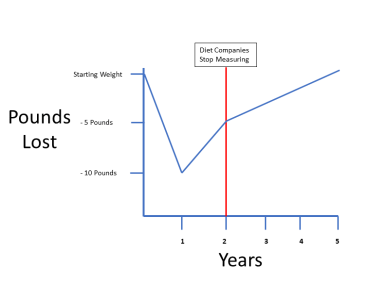
The diet industry has also made a habit of funding studies that only last for two years. A common outcome is that people who stay in the study lose 10 pounds in the first year, they gain back 5 of those pounds in the second year.

The study then stops, they make no attempt to figure out what happened to the people who quit (could it be that they weren’t losing weight?) and the diet industry claims that the majority of participants (meaning the majority of people who didn’t quit the study) ended below their starting weight after two years, which they often call “long-term success.” Of course two years isn’t really long-term anything, and they are conveniently ignoring the fact that the research that goes beyond 2 years finds that the trajectory of weight gain continues, and that most people gain it all back within about 5 years, with many gaining back more than they lost.

For a visual interpretation:
weight loss - studies and truth

Once again, what the research shows is that almost everyone can lose some weight short term. Almost everyone gains the weight back in 2-5 years. Knowing this, the diet industry claims “well, they go back to their old habits…” which is true only to the extent that they go back to not giving their body less calories than it needs to survive in the hopes that it will consume itself and become smaller. When people are talking about an intentional weight loss attempt and they say “it’s not a diet, it’s a lifestyle change” what they mean is “It’s a change to a lifestyle where you diet all the time.” Starvation is not sustainable.

There is nothing wrong with being fat, but even if someone thinks a large body is a problem, an intentional weight loss attempt is the absolute worst thing that they could do (and worst advice we could give them,) since it results in weight gain the majority of the time. For the research around this, I highly recommend Linda Bacon and Lucy Aprhramor’s Weight Science: Evaluating the Evidence for a Paradigm Shift.

We have to start telling the truth about weight and health or we risk coming to the end of our lives to find that we were so busy in the near impossible pursuit of a thin body (and lining the pockets of the diet industry in the process,) that we never took the time to truly live. I don’t know about you, but I wasted years trying to manipulate my body based on stereotypes of beauty and lies about health. No more. I live a full life in the body that I have. Getting off the diet roller coaster is always an option.

Did you like this post? If you appreciate the work I do, you can support my ability to do more of it with a one-time contribution or by becoming a member.

Like this blog?  Here’s more cool stuff:

The End of Year Sale is on! – Give the gift of body love and/or get your own year off to a Size Acceptance and Health at Every Size start with discounts on books, online programs, and DVDs to get your year (or the year of the people you’re gifting them to) off to a great start, and save you some money! (Dances With Fat Members get even bigger discounts, so make sure to use your link on the member page.)

Wellness for All Bodies ProgramA simple, step-by-step, super efficient guide to setting and reaching your health goals from a weight-neutral perspective.  This program can be used by individuals, or by groups, including as a workplace wellness program!
Price: $25.00 ($10 for DancesWithFat members – register on the member page)

Non-Members click here for all the details and to register!

Book and Dance Class Sale!  I’m on a journey to complete an IRONMAN triathlon, and I’m having a sale on all my books, DVDs, and digital downloads to help pay for it. You get books and dance classes, I get spandex clothes and bike parts. Everybody wins! If you want, you can check it out here!

Book Me!  I’d love to speak to your organization. You can get more information here or just e-mail me at ragen at danceswithfat dot org!

I’m (still!) training for an IRONMAN! You can follow my journey at www.IronFat.com or on Instagram.

If you are uncomfortable with my offering things for sale on this site, you are invited to check out this post.


via Dances With Fat http://bit.ly/2EUsozD

Friday, 28 December 2018

The Diet Industry- Your Drunk, Booty Calling Ex

Diet Industry booty callAh The Diet Industry. It promised you the world. And it was always good to you in the beginning, but over time it just couldn’t keep its promises, and you would break up. Then it would lure you back, convincing you it was responsible for everything good in your life, you would try again and then have to kick it out of your apartment when it went back to its old failing ways.

You would think you were done for good, but it would come back,  convincing you that you were to blame for the failed relationship and that you just needed to try harder – and you would give it another chance, only to have your heart broken again.

Then you started talking to the Diet Industry’s other exes and you learned that this was the pattern with almost every single one of them. Finally, you dumped the Diet Industry for good.

But the New Year is approaching and here’s the Diet Industry drunk and crying, calling, texting, e-mailing, sliding into your DMs, trying to convince you that it has changed (Now it’s going by its initials instead of its name! It’s a whole new person!) and it can give you everything you ever wanted if you just come back baby, please, just one more chance.

But the Diet Industry is lying – just like it always has – and, deep down, you know it. So remember that you can ignore that call, delete that text, block your shitty ex and keep living the amazing life that you can only live when the Diet Industry isn’t a part of it.

Did you like this post? If you appreciate the work I do, you can support my ability to do more of it with a one-time contribution or by becoming a member.

Like this blog?  Here’s more cool stuff:

The End of Year Sale is on! – Give the gift of body love and/or get your own year off to a Size Acceptance and Health at Every Size start with discounts on books, online programs, and DVDs to get your year (or the year of the people you’re gifting them to) off to a great start, and save you some money! (Dances With Fat Members get even bigger discounts, so make sure to use your link on the member page.)

Wellness for All Bodies ProgramA simple, step-by-step, super efficient guide to setting and reaching your health goals from a weight-neutral perspective.  This program can be used by individuals, or by groups, including as a workplace wellness program!
Price: $25.00 ($10 for DancesWithFat members – register on the member page)

Non-Members click here for all the details and to register!

Book and Dance Class Sale!  I’m on a journey to complete an IRONMAN triathlon, and I’m having a sale on all my books, DVDs, and digital downloads to help pay for it. You get books and dance classes, I get spandex clothes and bike parts. Everybody wins! If you want, you can check it out here!

Book Me!  I’d love to speak to your organization. You can get more information here or just e-mail me at ragen at danceswithfat dot org!

I’m (still!) training for an IRONMAN! You can follow my journey at www.IronFat.com or on Instagram.

If you are uncomfortable with my offering things for sale on this site, you are invited to check out this post.


via Dances With Fat http://bit.ly/2CEAk6D

Thursday, 27 December 2018

External Cephalic Version after Prior Cesarean - 2018 study


People whose babies are breech and have a history of a prior cesarean are often told that External Cephalic Version (ECV), manually encouraging the baby to turn head-down, is simply not a choice for them. The fear is that manipulation done during an ECV might make the uterus rupture along the scar from the prior cesarean.
We have discussed ECV after a Prior Cesarean extensively before. The results of all the studies so far suggest that ECV after prior CS is not unduly risky and can avoid many unnecessary repeat cesareans. ECV should be offered to women at term with a breech presentation, regardless of prior cesarean status. Unfortunately, ECV is woefully underutilized. One study from New Zealand estimated that only 26% of eligible patients with breech presentations were referred for ECV.

2018 Study

Recently, a new study (Impey 2018) was published that looks again at the question of ECV after prior cesarean (CS). Its results were both encouraging and disappointing.

In this new U.K. study, researchers looked back retrospectively over a 16 year period and found 100 cases where babies of women with a prior cesarean presented breech at term, were offered, and consented to a ECV.

Basically, the study found about a 50% rate of success in turning the baby head-down. Those who had head-down babies afterwards had a trial of labor after cesarean (TOLAC), and 68% had a VBAC.

The authors did a literature search on ECV after prior CS and found no increased rate of uterine rupture after ECV. That agrees with the literature search we did.

However, the authors chose to dilute this good news by pointing out that while ECV avoided some cesareans, only 30 women out of the 100 original group had a VBAC. In other words, while they found the practice safe, the way they word the abstract made it sound like instituting a practice of ECV after prior cesarean is not worth pursuing because it is only marginally successful.

This flies in the face of previous research. The big question is why their ECV success rate was so low. Only 50% of their ECV tries worked to turn the baby head-down. That reduced their candidates for TOLAC by half, and then only about 2/3 of these women had a VBAC. That's why the final numbers were low.

If you look at comparable studies, Weill 2016 had a 74% ECV success rate, while Burgos 2014 had a 67% ECV success rate. Why were their results so much better? That's what the UK study authors should be asking themselves. Seems like they need training on how to do ECV more successfully.

Summary

The good news from the study is that External Cephalic Version after a prior cesarean is safe. There are potential risks inherent to the procedure, of course, but these risks do not appear to be any greater in women with prior cesarean than in those without a prior cesarean. And of course, the alternative of an automatic repeat cesarean with a breech carries its own potential risks that also must be considered. The choice should be up to the mother.

The bad news from the study is how few women with prior cesareans are being offered ECV and how low the ECV success rate was. It took 16 years in the study to find a data pool of 100 women who had a prior cesarean and a breech presentation at term who were offered an external version and who accepted it. ECV is tremendously underused, especially in those with a prior cesarean. And a ECV success rate of only 50% is pitiful. Better training is obviously needed.

External Cephalic Version at term can avoid many unnecessary cesareans, yet it is woefully underused in many institutions. It is a reasonable choice that needs to be expanded, especially in women with prior cesareans. Furthermore, training to achieve greater ECV success rates in more places needs to occur.


References

Eur J Obstet Gynecol Reprod Biol. 2018 Dec;231:210-213. doi: 10.1016/j.ejogrb.2018.10.036. Epub 2018 Oct 22. External cephalic version after previous cesarean section: A cohort study of 100 consecutive attempts. Impey ORE, Greenwood CEL, Impey LWM. PMID: 30412904
OBJECTIVE: External cephalic version is commonly not performed in women with a previous cesarean section. Fear of uterine rupture and cesarean section in labor are prominent. The risks, however, of these are unclear. This study aims to document the safety and efficacy of external cephalic version in women with a prior cesarean section in a series of 100 consecutive attempts, and to perform a literature of the existing literature. STUDY DESIGN: This is a retrospective cohort study of prospectively collected data of external cephalic version attempts in women at term with a previous cesarean section, and a literature review of previously published series. External cephalic version was performed by one of 3 experienced operators, with salbutamol tocolysis if appropriate, using ultrasound to visualize the fetal heart and place of fetal parts. RESULTS: 100 women with a prior cesarean section underwent external cephalic version over a 16-year period in one institution. 68% had no previous vaginal delivery. The external cephalic version success rate was 50%, and 30 (63.8%) of these subsequently delivered vaginally. There were no cases of uterine rupture or other complications. A literature review of series containing a total of 549 cases revealed no cases of uterine rupture or perinatal death. CONCLUSIONS: External cephalic version in women with a prior cesarean section is safe but enables a vaginal birth in only about a third of women.
Aust N Z J Obstet Gynaecol. 2016 Sep 14. doi: 10.1111/ajo.12527. [Epub ahead of print] The efficacy and safety of external cephalic version after a previous caesarean delivery. Weill Y, Pollack RN. PMID: 27624629
BACKGROUND: External cephalic version (ECV) in the presence of a uterine scar is still considered a relative contraindication despite encouraging studies of the efficacy and safety of this procedure. We present our experience with this patient population, which is the largest cohort published to date. AIMS: To evaluate the efficacy and safety of ECV in the setting of a prior caesarean delivery. MATERIALS AND METHODS: A total of 158 patients with a fetus presenting as breech, who had an unscarred uterus, had an ECV performed. Similarly, 158 patients with a fetus presenting as breech, and who had undergone a prior caesarean delivery also underwent an ECV. Outcomes were compared. RESULTS: ECV was successfully performed in 136/158 (86.1%) patients in the control group. Of these patients, 6/136 (4.4%) delivered by caesarean delivery. In the study group, 117/158 (74.1%) patients had a successful ECV performed. Of these patients, 12/117 (10.3%) delivered by caesarean delivery. There were no significant complications in either of the groups. CONCLUSIONS: ECV may be successfully performed in patients with a previous caesarean delivery. It is associated with a high success rate, and is not associated with an increase in complications.
BJOG. 2014 Jan;121(2):230-5; discussion 235. doi: 10.1111/1471-0528.12487. Epub 2013 Nov 19. Is external cephalic version at term contraindicated in previous caesarean section? A prospective comparative cohort study. Burgos J, Cobos P, Rodríguez L, Osuna C, Centeno MM, Martínez-Astorquiza T, Fernández-Llebrez L. PMID: 24245964
OBJECTIVE: To determine if external cephalic version (ECV) can be performed with safety and efficacy in women with previous caesarean section. DESIGN: Prospective comparative cohort study. SETTING: Cruces University Hospital (Spain). POPULATION: Single pregnancy with breech presentation at term. METHODS: We compared 70 ECV performed in women with previous caesarean section with 387 ECV performed in multiparous women (March 2002 to June 2012). MAIN OUTCOME MEASURES: Success rate, complications of the ECV and caesarean section rate. RESULTS: The success rate of ECV in women after previous caesarean section was 67.1% versus 66.1% in multiparous women (P = 0.87). The logistic regression analysis confirmed this result (odds ratio 0.93, 95% CI 0.52-1.68; P = 0.82) adjusted by the variables associated with success of ECV. There were no complications in the previous caesarean section cohort. The vaginal delivery rate in the previous caesarean section cohort was 52.8% versus 74.9% in the multiparous cohort (P < 0.01). There were no cases of uterine rupture. CONCLUSION: Based on our data, we conclude that complications are uncommon with ECV in women with previous caesarean section, with a success rate comparable to that of multiparous women. Uterine scar should not be considered a contraindication and ECV should be offered to women with previous caesarean section with breech presentation at term.
Click here for older references on ECV after CS.


via The Well-Rounded Mama http://bit.ly/2CDujqT