The post appeared first on Evolving Fatshionista.
via Evolution of a Fat Fashionista » Feed https://ift.tt/3yu7kIG
The post appeared first on Evolving Fatshionista.

I’ve been struggling to do more than 10 minutes on the treadmill for months. I’ve also been concerned that my pulse was anaerobically high when I’d finish on the treadmill. I’d been toying with going to shorter times and just doing more of them, and then the new endocrinologist suggested the same. I’ve started doing 5 minute sessions, and found that 3 of them is doable. My pulse doesn’t get above aerobic levels; to put it another way, I’m staying in “vigorous”, sometimes even “moderate”. And I’m still feeling the exercise, all right.
I’ve been reading Every Body Yoga and doing six or so asanas, twice a week. I’m also getting on and off the floor twice a week – something that before my pulmonary embolism I didn’t regard as all that remarkable. In my case and my current levels of fitness, I’m using our bedframe (specifically the side rail) as a support in going down and up. I didn’t need that 5 years ago, and I’m working to not need it in the future. Still, like yoga teachers have told me many times, if a prop helps, use it!
Other props I have used to get off the floor are our coffee table and a chair. Do I need to write that I do not trust just any piece of furniture? Because no, I don’t. I also find – while the man of the house is always ready to help – it can be best for him to hold a sturdy chair steady for me, instead of him bending over. This saves his back.
Strength training is the same stuff I’ve been writing about for years, and it’s key to keeping everything else working :)
New doctors tend to result in me being anxious. In this case, it was a new endocrinologist. Reasons include: new insurance doesn’t support the prior endocrinologist and the prior endocrinologist is a sole proprietor leading to delays for anything. New endocrinologist was selected from the group practice at the hospital system where I have everything else. They know how my insurance works and they have support staff.
The prior endocrinologist was also great at pushing my buttons, but I wasn’t sure I’d find a better one.
To my surprise – and after stressing for days – the visit with the new doctor went well. Staff did not show surprise about my arriving on a mobility scooter. They were fine with me “parking” it in the waiting room, and pointed out I could use it the entire time. I explained I’m more comfortable walking in the more closed in offices, but the scooter made it easier to navigate the hospital complex where their office is located. The waiting room had a variety of chair widths; the exam room had a wide chair, exam table, a stool, and another chair. I was able to move comfortably. The blood pressure cuff was appropriate.
I arrived with a list of things to discuss, mostly involving meds. I was treated respectfully. I was not told to diet. I was not asked what I eat, much less lectured on my assumed eating habits. We discussed tests to check on my hypothyroid and other function. I agreed with the recommendations. One prescription was renewed. I was given written directions to the lab for my tests (down the elevator, down the sloping ramp to another building – this is why I brought the scooter).
That afternoon I had email notifying me of an update in the hospital system’s portal. My labs were fine. I was reminded to feel free to reach out in the portal if I have questions or need another prescription.
Overall, I’m relieved.
I’m also a bit frustrated that being relieved is good, and that my expectations were low based on experience.
I look at clothes and think of how they’re like other clothes that I already have. Do I need more clothes? Or do I need to do laundry more often?
Sadly, “just wash clothes more frequently” is the easiest option…

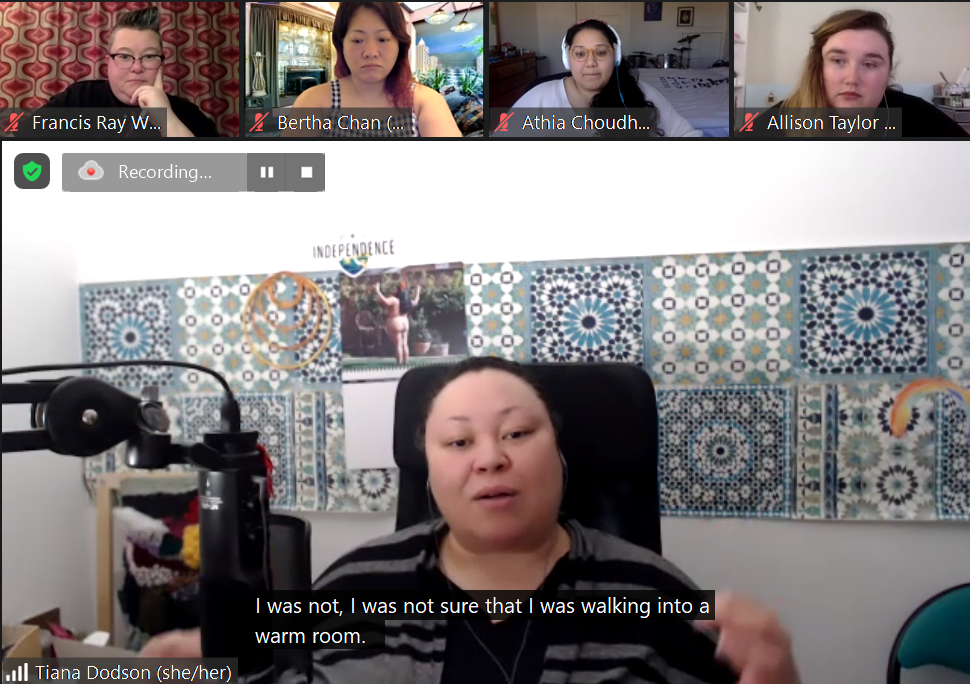
The International Handbook of Fat Studies was published by Routledge on 19 April 2021. To celebrate this momentous occasion, many of the contributors joined myself and Sonya Renee Taylor to launch the book with a global Zoom.

Contributing authors from Canada, the United States, France, the UK, South Africa, Hong Kong, Finland, and Australia all helped us launch the book, along with about 35 people interested in Fat Studies scholarship and activism. It was a fatlicious mix of academics and activists.

The Handbook brings together a diverse body of work from around the globe and across a wide range of Fat Studies topics and perspectives. The first major collection of its kind, it explores the epistemology, ontology, and methodology of fatness, with attention to issues such as gender and sexuality, disability and embodiment, health, race, media, discrimination, and pedagogy. Presenting work from both scholarly writers and activists, this volume reflects a range of critical perspectives vital to the expansion of Fat Studies and thus constitutes an essential resource for scholars in the field. We are proud that contributors to the Handbook hail from fifteen countries; we are also proud that half of the Handbook was written by activists.
Many of the contributors responded to the CFP, while others were belly bumped by me to join. The resulting work challenges traditional ideas about fatness, reviews existing discourse about fatness, and produces new debates about fatness. There are gaps, though. Some of these gaps exist due to contributions that failed to materialise; some exist because of the paucity of scholarship on a singular topic.
As Sonya Renee Taylor and I note in the conclusion of the introductory chapter,
This International Handbook of Fat Studies meets the world at a time of great upheaval. A moment in history where those navigating lives at the intersections of various oppressions are demanding change and one where those who have been historically nescient to these experiences are being ushered into greater awareness. Fat Studies and fat activism sit at the precipice of an emerging world, one where fat bodies and their liberations cannot be disaggregated from the liberation of all oppressions. We believe the work in this book invites you, the reader, into a more nuanced and yet expansive landscape of fat scholarship. We believe there is also a necessary summons into the queries, harms, and hopes of fat lives beyond the too often foregrounded western narratives. Most importantly, within these pages is an offering for Fat Studies and all who are impacted by the field to live juicier, more abundant, more robust existences. We hope we fatten up your world.
We have such high hopes for this Handbook, but we recognize that as an academic text, the cost makes it inaccessible to many people. We are asking that people request that their local library (University, community, etc) order a copy of the Handbook. If you like to purchase a personal copy, you can find the eBook at a discount price from the publisher.

ToC
Chapter One: Fattening scholarship byCat Pausé and Sonya Renee Taylor
Section One – Defining fat
Chapter Two: “Am I fat?” by Darci L. Thoune
Chapter Three: Quantifying or contributing to antifat attitudes? by Patricia Cain, Ngaire Donaghue, and Graeme Ditchburn
Chapter Four: Language, fat and causation by Kimberly Dark
Chapter Five: My life is intersectional, so my coaching has to be by Tiana A. Dodson
Section Two – Theorising fat
Chapter Six: Feminism and fat by Amy E. Farrell
Chapter Seven: Big, fat, Greek modernities by Sofia Apostolidou
Chapter Eight: Does that mean my body must always be a source of pain? by Laura Contrera
Chapter Nine: Fatness and consequences of neoliberalism by Hannele Harjunen
Chapter Ten: Fat and transgender by Francis Ray White
Chapter Eleven: Fatness and disability by April Herndon
Section Three – Fat in the institution
Chapter Twelve: Fat in the media by Katariina Kyrölä
Chapter Thirteen: Being fat in a thin world by Amena Azeez
Chapter Fourteen: Fattening education by Erin Cameron and Constance Russell
Chapter Fifteen: Fatness, discrimination & law by Stephanie von Liebenstein
Chapter Sixteen: Pregnancy, parenting and the challenge of fatness by May Friedman
Chapter Seventeen: Fat Studies and Public Health by Natalie Ingraham
Section Four – Living fat
Chapter Eighteen: Reclaiming voices from stigma by Jenny Lee and Emily McAvan
Chapter Nineteen: Save the whales by Kath Read
Chapter Twenty: Fat hatred and body respect by Tara Margrét Vilhjálmsdóttir
Chapter Twenty-One: Desirability as access by Nomonde Mxhalisa
Chapter Twenty-Two: The impact of being a fat Chinese woman in Hong Kong Bertha Chan
Chapter Twenty-Three: Surviving & thriving while fat by Sonalee Rashatwar
Chapter Twenty-Four: Review of scholarship on fat gay men by Jason Whitesel
Section five – Fat disruptions
Chapter Twenty-Five: Genealogies of excess by Athia N. Choudhury
Chapter Twenty-Six: When you are already dead by Hunter Ashleigh Shackelford
Chapter Twenty-Seven: TransFat by Sam Orchard
Chapter Twenty-Eight: Lesbians and fat by Esther D. Rothblum
Chapter Twenty-Nine: What’s queer about Fat Studies now? by Allison Taylor

As we start to emerge from COVID quarantine and diet companies rush to take advantage of ensuing fatphobia, here’s a quick reminder:
There isn’t a single study where more than a tiny fraction of people are able to maintain significant, long-term weight loss.
Almost everyone gains all their weight back, many gain back more than they lost.
Those are the facts. That’s why diet companies are required to put disclaimers on every advertisement – they are legally obligated to say “our products hardly ever work” every single time they talk about them.
Diets don’t work – not even if you call them a “lifestyle change” or a “healthy eating plan” or WW instead of Weight Watchers, or something else. Attempts to manipulate body size with food and/or movement almost always fail. (For more research around this, check out the HAES Health Sheet Site!)
Happily, Fat Acceptance and Health at Every Size give us real options for having a positive relationship with our bodies, food, and movement.
In this workshop we’ll learn how to uncover the fatphobic beliefs that we’ve internalized, understand how they are affecting us, apply practical options for dealing with them and, finally, learn how to make sure we don’t internalize new fatphobia in the future. We’ll learn how to stop fighting our bodies on behalf of weight stigma, and start fighting weight stigma on behalf of our bodies. There will also be a video of the talk provided, and an unlimited live Q&A (I stay until all the questions are answered!) so you are guaranteed to get the information you came for!
Details and Registration: https://danceswithfat.org/monthly-online-workshops/
*This workshop is free for DancesWithFat members – login info is on the member page
Become a member here!
Missed one of my workshops? You can still get the video here!
Like This Blog? If you appreciate the work that I do, you can support my ability to do more of it with a one-time tip or by becoming a member. (Members get special deals on fat-positive stuff, a monthly e-mail keeping them up to date on the work their membership supports, and the ability to ask me questions that I answer in a members-only monthly Q&A Video!)
Book Me! I’d love to speak to your organization (and I can do it remotely!) You can get more information here or just e-mail me at ragen at danceswithfat dot org
